When choosing a second-hand forklift truck with a lifting capacity of between 1.5 and 3 tonnes (e.g. the popular Toyota 8FG series models with a 4Y engine), buyers are counting on legendary Japanese reliability. However, on the second-hand market, it is common to come across machines that have undergone so-called ‘garage repairs’. One of the most common problems is the replacement of the original Japanese LPG regulator with a cheap, generic equivalent from the automotive industry.
At first glance, a forklift with this type of evaporator starts up and lifts loads. However, in the demanding conditions of a busy warehouse, this modification quickly leads to downtime and costly breakdowns.
Why isn’t the Aisan factory-fitted LPG conversion kit just a standard car LPG system?
Unlike a passenger car, where the load on the engine increases smoothly during acceleration, a forklift operates under conditions of sudden load changes.
When the operator suddenly pulls the hydraulic lever to lift a pallet weighing 1.5 or 2.5 tonnes, the hydraulic pump instantly exerts enormous resistance on the engine shaft. In that fraction of a second, the fuel system must deliver a precisely metered dose of fuel.
- Aisan (or Nikki) factory-fitted pressure regulator: It is specifically designed to meet the requirements of industrial motors. It features high-sensitivity diaphragms and specially contoured channels, which prevent pressure drops during sudden hydraulic loading.
- Car pressure regulator (Tomasetto, Lovato, Atiker, etc.): This is designed for gentle driving. If the forklift’s hydraulics are activated abruptly, such a regulator causes a drastic drop in pressure — the engine loses power, starts to stall or cuts out whilst the load is still on the forks.
Comparison: Genuine Aisan vs. Universal Car Regulator
| Parameter | Aisan (Toyota) original equipment pressure regulator | Universal car regulator |
| Reaction to the hydraulics | Instant throttle response without a drop in revs | Power drops, risk of the engine stalling under load |
| Installation instructions | A dedicated body fitted to the original handles | Requires custom-made flat bars and modifications |
| Clips and fastenings | Toyota spring-loaded self-locking clamps | Standard screw-on cable ties (require tightening) |
| Service life of the membrane | 5–8 years of intensive forklift operation | 1–2 years (rapid wear under load) |
| Fuel mixture | A consistent line-up across all areas | The risk of a lean mixture and valve burn-out |
4 visual signs that an LPG system has been modified
Photo 1: Non-original car regulator — a simple round body, a custom-made flat mounting bracket, worm drive clamps and universal blue connectors.
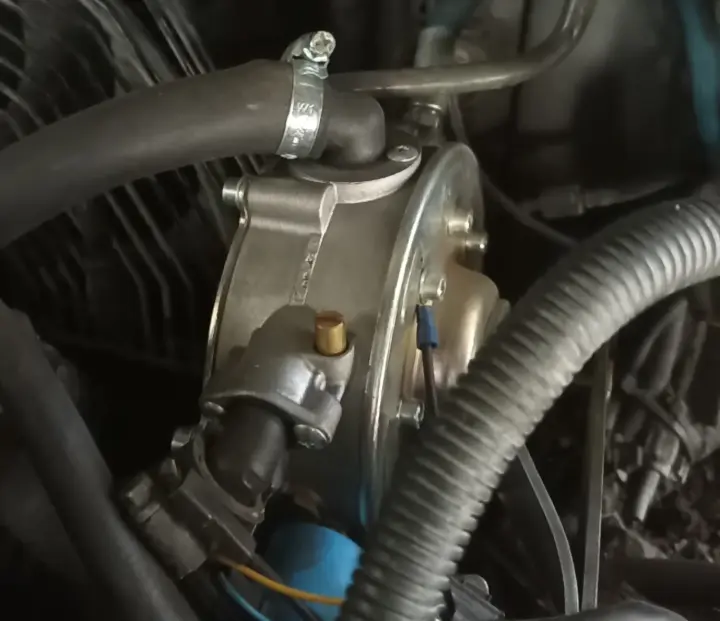
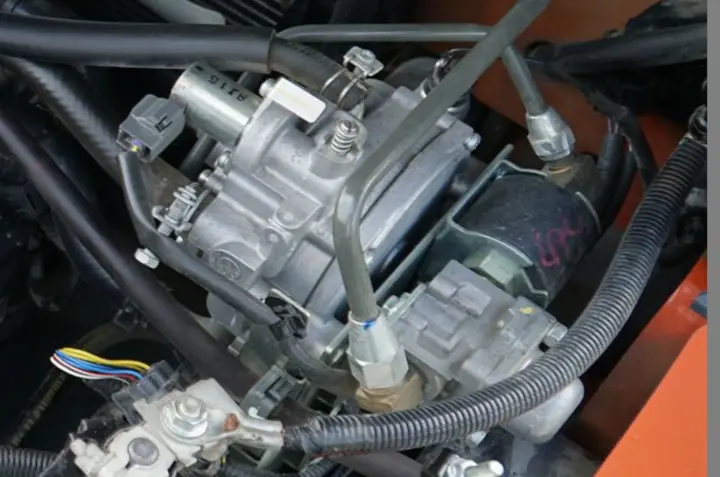
Photo 2: Genuine Aisan regulator (Toyota OEM) — solid aluminium casting, integrated LPG solenoid valve on a rigid tube, upper start-up/idle valve (part number 8J15), sealed connectors and spring clips.
- Body shape and integrated solenoid valve:
- Genuine Aisan: A solid cast unit with an integrated high-pressure gas solenoid valve (with a coil and ‘LPG’ marking) mounted on a rigid metal tube. It also features an upper valve for start-up assistance and idle speed control (with an engraving, e.g. 8J15) and a spring-loaded adjustment screw.
- Alternative: A simple, round body (‘disc’) without any additional control valves, to which gas is often supplied via a flexible hose
- Electrical system and manufacturer’s markings:
- Genuine Aisan: Sealed, grey industrial plugs (dust- and warehouse-moisture-resistant), factory engravings and stickers with OEM barcodes.
- Alternative: Standard car connectors (e.g. blue plugs), no sealing and exposed wires susceptible to corrosion.
- Mounting brackets:
- Genuine Aisan: Fitted to dedicated, factory-fitted brackets designed to absorb engine vibrations.
- Alternative: Mounting on a makeshift bent flat bar or tightening it ‘by force’ in a random spot.
- Cables and cable ties:
- Genuine Aisan: Exclusively steel spring clamps (self-locking) that maintain constant pressure regardless of engine temperature.
- Alternative: Standard screw-on clamps for a screwdriver, which come loose due to vibrations and cause coolant or gas leaks.
What are the risks of buying a pram with a ‘random’ regulator?
- Reduced work efficiency: The operator will not be able to manoeuvre efficiently and lift heavy loads quickly at the same time.
- Valve seat burnout: A poorly adjusted car fuel regulator often delivers a mixture that is too lean. Burning a lean mixture generates a much higher temperature, which leads to the exhaust valves in the engine burning out.
- Start-up problems and freezing: Incorrect connection to the cooling system results in the reducer not heating up sufficiently and the diaphragm freezing on colder days.
Why buying a used forklift at a Japanese auction is a safer choice?
In Japan, forklift trucks undergo regular technical inspections at authorised service centres. In the event of a breakdown, Japanese service engineers replace components with genuine OEM parts, without resorting to cheap stopgap measures or makeshift garage repairs.
When you buy a second-hand 1.5–3 t forklift truck imported directly from a Japanese auction, you receive a machine in factory-new condition — with full performance, a reliable service life and no surprises with the LPG supply system.