If you have been following my posts for some time and browsing the photos of used forklifts that I have on offer, you have surely noticed one recurring detail. In 2-3 photos of the forklift, there is a special gauge applied to the mast chain (as shown in the picture above).
You often ask: “What is this scale, what is it for, and why do I attach such importance to it?”
Today I will explain exactly what this device is, how to read it, what the wear standards are, and what the consequences of ignoring this element are.
What is this device and what is it used for?
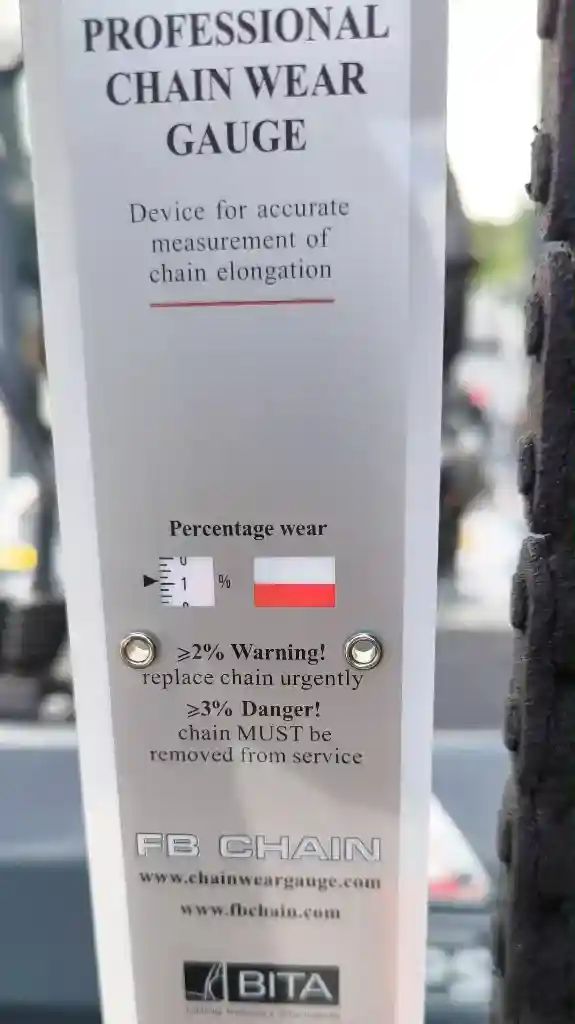 In the picture, you can see the wear (gauge) and elongation gauge for plate chains.
The mast chain of a forklift is a key element of the lifting system. It is what holds and lifts pallets weighing 1.5, 2, 2.5 or more tons. Over time, under the influence of huge dynamic loads, the chain wears out.
It is worth knowing: the metal of the plate itself practically does not stretch. The “stretching” of the chain results from microscopic wear at the friction points — at the junction of the pins and plates. The pitch of the chain increases, and as a result, the entire chain becomes longer.
Assessing this wear “by eye” is impossible. Even if the chain looks clean and is well lubricated, it may be in a critical state. This is what this gauge is for: it measures elongation over a specified section and immediately indicates the percentage of wear.
How to read the results: standards and critical values
The device clearly indicates international safety standards (in accordance with, among others, UDT guidelines), which must be followed by every service technician and equipment owner:
0% – 1.5% (Safe Zone) — Standard. The chain is in excellent technical condition. In my photo, the indicator shows wear at about 1%, which indicates minimal wear and full readiness for operation under heavy load.
>= 2% (Warning!) — Urgent replacement! At 2% wear, the chain's durability drastically decreases, and the wear of cooperating elements accelerates. The chain should be included in the nearest service plan and replaced as soon as possible.
>= 3% (Danger!) — Critical wear! The trolley must be IMMEDIATELY withdrawn from service (chain MUST be removed from service). Working with such a chain poses a direct threat to health and life.
What will happen if you ignore chain wear?
Some trolley owners believe: “As long as it doesn't break, let it work”. This is a huge mistake. Here’s what ignoring measurements leads to:
Chain breakage and load fall. The worst, but unfortunately common scenario. A chain break at several meters high means a two-ton pallet will fall. This means destruction of goods, serious damage to the trolley, and a direct threat to the operator and people nearby.
Destruction of rollers and chain wheels. A chain with a changed pitch does not sit properly on the rollers and mast wheels. It literally starts to wear and deform the expensive components of the lifting system.
Tilt of the carriage and hydraulic failure. Chains usually stretch unevenly (left and right). This causes the carriage to tilt, uneven loading of the cylinders, oil leaks, and faster wear of the mast guides.
Problems with UDT acceptance and insurance. A cart with a stretched chain simply will not pass the periodic UDT inspection. And in the event of an accident, the insurer will refuse to pay compensation, stating a failure to meet basic safety standards.
Why do I always take this photo when selling used equipment?
Buying a used forklift is a matter of trust. Cleaning the plastics and painting the counterweight can be done by anyone. But the true technical condition lies in the components responsible for safety.
When I list the cart for sale and include a photo of this gauge:
You see the actual condition of the chains without the need to take my word for it.
You know that right after the purchase, you won't face significant expenses for a new set of chains and their replacement.
You can be sure that the equipment has undergone thorough pre-sale diagnostics.
Safety and transparency are priorities when choosing warehouse equipment. Now you know what to pay attention to when inspecting the cart!
Do you have questions about selecting a forklift or mast diagnostics? Write to me — I will be happy to help!